Is Preikestolen worth it?
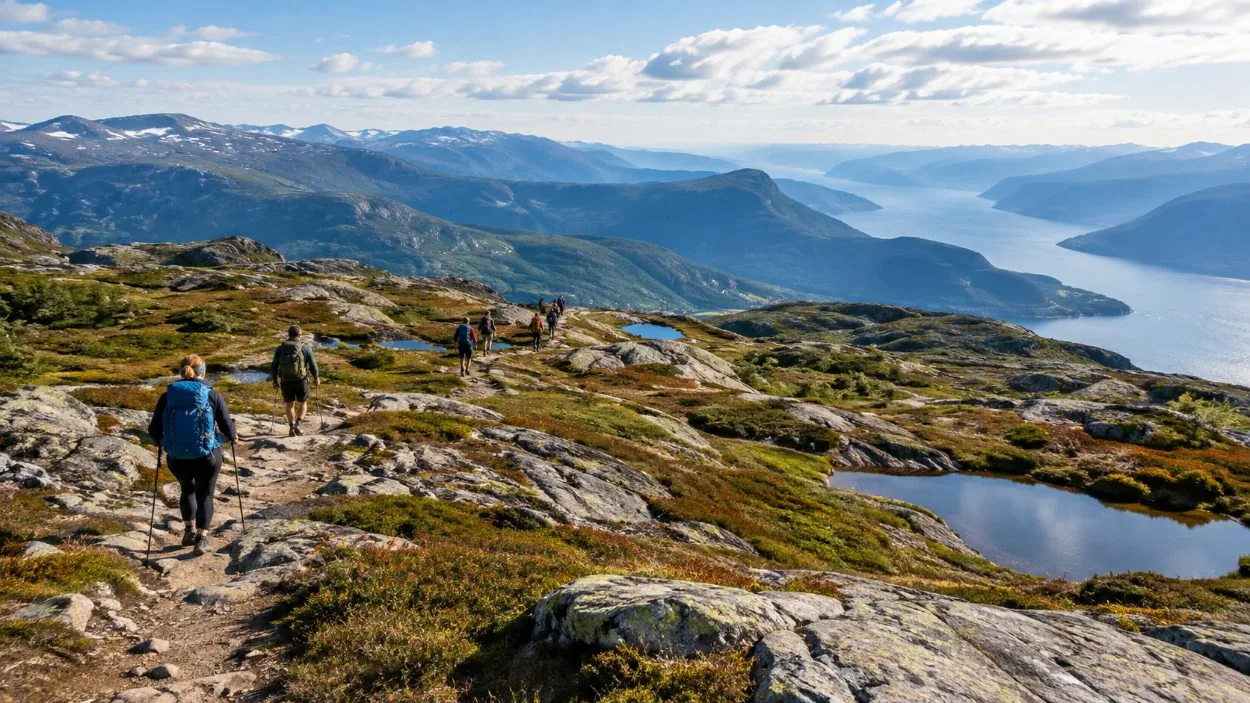
Why I still say yes
Because the last ten minutes are genuinely unlike anything else, and because the walk earns them. You come out of the trees, over the marsh boardwalks, along bare rock with the fjord opening up on your left, and then onto a flat granite tongue with 604 metres of air under it. It is not a viewing platform someone built. It is a piece of the mountain that happens to be flat, left behind when the ice pulled the rest of the wall away about ten thousand years ago. Standing on it is a strange sensation and it does not wear off.
It is also, for once, not ruined by being famous. Roughly 350,000 people a year walk up, and the trail can be a queue in July, but the plateau is big enough and the fjord is long enough that the scale of the thing survives the crowd. Timing helps a great deal: how to miss the crowds.
Who should not do this hike
Anyone who wanted a viewpoint with a car park at the top. There is no road, no lift, no shuttle to the plateau. It is about 8 km on foot with roughly 350 to 500 metres of climbing, depending on how you count the dips. If that is not the day you had in mind, read how hard it is before you book anything.
Anyone who is unhappy near an edge. There is no railing, no fence and no barrier at the top, deliberately, because the land managers want the site left as it is. The plateau simply ends. A fall from it is around 250 metres and is not survivable. Plenty of people stand well back and have a fine time; some find the whole place unbearable, and there is no shame in being one of them: the no-fence page.
Anyone whose knees are the weak point. The descent is where the trail collects people. Two to two and a half hours of stepping down onto uneven stone with tired legs is harder on a bad joint than the climb ever was. See the injuries page.
Anyone with three hours in port. Independently from a ship it is about an hour out, four to five hours walking and an hour back. Against a typical call that fits with no margin at all, and a missed bus is a missed ship: the cruise-ship arithmetic.
Small children in winter conditions. The official advice is not to take children under five up in winter, and I would go further and say the whole trail in snow is an adult decision: going with children.
What works
- A plateau you walk onto, not a platform someone built for you
- Free, unticketed and open at any hour you like
- Well marked, with Sherpa-built stone steps on the worst sections
- Close enough to Stavanger to be a day out rather than an expedition
- September gives you the trail in good condition and half the people
Worth knowing
- Four to five hours of uneven ground, which nobody warns you about
- The plateau is often in cloud, and no one can promise you the view
- No railing, and the drop is around 250 metres
- June to August the trail is busy and the car park fills
- Hard on knees and ankles going down, which is where people come unstuck
If the hike is not for you, do not force it and do not skip the place. Take the boat instead and see the cliff from directly below, which is a view the people standing on top do not get. It is the answer for bad knees, small children, three hours in port and February alike.
The honest alternative
The Lysefjord cruise runs from Strandkaien in Vågen on a fully electric catamaran, takes three and a half hours, and passes Preikestolen from underneath. It does not land and you do not reach the plateau from it. For a large share of the people who ask me whether the hike is worth it, this is the better day: the cruise. If you want both, the long combined day exists: cruise and hike.
If you have decided yes
Then the next question is transport, not boots. The guided day from the cruise terminal is below; the rest are on the bookings page.
A reminder about what that widget is. It books the ride out of Stavanger and, on most of these, a guide. It does not book Preikestolen. Nobody sells a ticket to the trail: it is free, open and unguided, and you can walk up it without paying anyone a thing.
Frequently asked questions
Is Preikestolen worth visiting?
Yes, if you expect a four to five hour mountain walk. The people who come away disappointed were expecting a viewpoint: how hard it is.
Is it too crowded to enjoy?
June to August it is busy on the trail. September is much quieter with the ground still in good condition: best time to visit.
What if I am afraid of heights?
There is no railing and the plateau simply ends. Some people stand well back and manage; others should take the boat instead: the cruise.
Is the view guaranteed?
No. The plateau is often in cloud and nobody can promise otherwise: weather and rain.